
Movie Review: ‘The Odyssey’ finds humanity under the myth

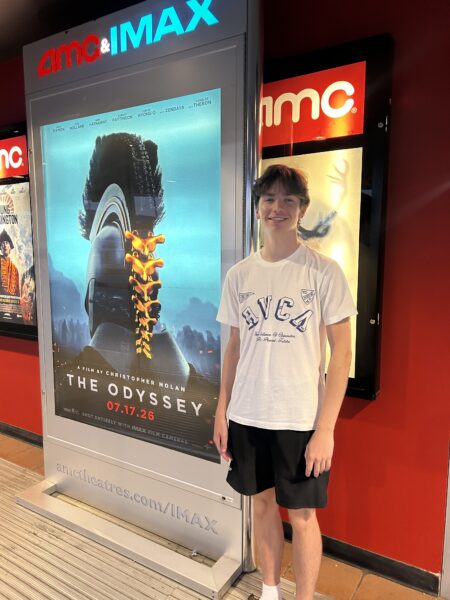
Mykola Washchuk at AMC Quarry Cinemas 14 theater in Hodgkins, IL.
By Mykola Washchuk – Staff Writer
Homer’s “The Odyssey” is around 3,000 years old. Its relevance, and adaptation in modern cinema, makes it one of the most influential works to date. The story follows Matt Damon playing Odysseus, who spends ten years trying to return home after the fall of Troy.
Presentation and theme
Christopher Nolan’s sweeping new opus “The Odyssey” (2026) opens with a title card placing it in the Bronze Age as a “time of apparent magic.” The title card immediately drew me into Nolan’s interpretation of his human-oriented epic.
It’s this expository phrase that establishes the nature of this year’s new spectacle — a film that blurs the connection between human trauma and supernatural reality.
It’s also this title card that makes it an exclusively “Nolan” movie, one that deals with the consequences of the past, and the taxing force that is time and mortality: thematically mirroring the former-most recent of Nolan’s films, “Oppenheimer”(2023). “The Odyssey” is one of Nolan’s most cohesive thematic continuations, and perhaps his most emotionally mature screenplay since “Interstellar.”
Nolan’s “The Odyssey” is heavily human: the Mediterranean waves crash and batter ships instead of a physical Poseidon God, lightning flashes and crashes in place of Zeus’ wrath, and the clanging of swords and slitting of blood takes the place of any conceived God of war.
As a result, the term “apparent” within the opening title card prompts the audience to question the mythology of the gods, as Odysseus’ crew similarly becomes blinded by a barbaric human nature. That ambiguity lingers long after the credits, making the film feel richer on reflection than during its immediate spectacle.
Throughout Odysseus’ time away, he has left his wife Penelope (Anne Hathaway) and son Telemachus (Tom Holland) in Ithaca. Hathaway plays a poised and fierce Penelope, while Holland manages to capture the helpless and transformative Telemachus. All the while, the security of the kingdom is threatened by suitors — most prominently Antinous (played by an aggressive Robert Pattinson) and Polybus (Corey Hawkins) — that bleed the palace dry of wine, supplies, and dignity, on the pretense that Odysseus is long dead. Hawkins and Pattinson especially fuel the narrative with their performances, their increasingly encroaching behaviors creating a threatening urgency for Odysseus to return home.
“The Odyssey” rarely depicts the gods as tangible beings intervening in human affairs. Their presence instead becomes inseparable from the natural world itself. Athena, played by Zendaya, with an insightful, quiet divinity, often feels less like a physical presence and rather, an extension of Odysseus’ own conscience. I found this approach far more engaging than a literal depiction of the gods because it allows the mythology to feel personal rather than fantastical.
Nolan successfully invites the audience to question whether divine punishment originates from supernatural forces, or whether humanity itself manufactures the gods through its own capacity for violence and belief. Making the film feel based in realism, focusing on the societal aspect of ancient Greece, proficiently transporting the audience to the lives of the people, stringing us along its journey. For me, this grounded approach makes “The Odyssey” far more emotionally affecting than any modern mythological epics.
Production design
But the destination, the goal of return, to Ithaca is merely a conclusion to the story. Homer’s “The Odyssey” is widely regarded as the foundational ‘journey’ story —the destination is nothing without the journey — and Nolan certainly takes us on an expedition of a widely inconceivable time period.
Ruth De Jong, the set and production designer for “The Odyssey,” constructs a setting that is fitting for the fully IMAX film: monumental, colossal, and grandiose. De Jong’s faith to the ancient, sweeping time period completes the film as a titan in immersion.
She previously collaborated with Nolan on “Oppenheimer,” and is now assembling in impressive locations for the film across Greece, Italy, Morocco, Iceland, and Scotland — such as the wooden brazen Trojan horse that stunningly marks the first scenes of the movie filmed on the Atlantic coast of Morocco. The sheer scale of “The Odyssey” seems to honor the utter magnitude of the mammoth that is Homer’s epic poem; the amount of detail and effort that goes into crafting each scene is enough to make this film one of high caliber.
I rarely questioned the reality of what I was seeing, an increasingly rare achievement in blockbuster filmmaking. The length that De Jong and Nolan go to craft physical set design instead of computer-generated imagery (CGI) ensures that “The Odyssey” is a film of marvelous, even absurd, scale.
The applause shouldn’t stop there; the audience shouldn’t just ogle at the greatness of size, but the attribute that the story remains emotionally rich and compelling in many moments, with scenic design to only accentuate the many character moments.
Cinematography
The cinematography of Nolan’s “The Odyssey” can be attributed to Hoyte Van Hoytema, the film’s Director of Photography and Cinematographer, who depicts the torch-fires that light the night — and moral — darkness of the many kingdoms of Greece.
The ‘Greek’ ships that Nolan employs as the tool for their travel are shown in all their length and tribulation, making it easy to brush off the fact that these ships are dated towards the Viking period, which many maritime historians point out to be outside of the time period in which the story took place.
Hoytema and Nolan seem to hold back on the breadth of viscerality that Homer’s epic piece of literature entails. Instead, reverting towards a style and color-scale that is traditionally “Nolan-esque”: a highly naturalistic, even muted, visual theme that looks reminiscent of his former works such as “Inception” (2010), or “Tenet” (2020).
Films that rely on futuristic, technological plotlines. Something that is polarizing to the mythos that “The Odyssey” fantastically seals. For me, this becomes the film’s greatest artistic weakness; Homer’s poem is a descriptive, enigmatic work that constantly takes time to describe visceral colors. This is largely disregarded with Nolan’s artistic choice to rely on a sleek color scheme, rather than a rich, saturated one — taking away from the spiritual prowess that “The Odyssey” contains. This is one of the moments where Nolan’s trademark style actively works against the material.
The writing
Homer’s Odyssey has exactly 12,109 lines. The ancient Greek epic poem is written in dactylic hexameter — six rhythmic ‘feet’ of syllables per line — it is further divided into 24 books, or chapters, in a way. As someone who has read “The Odyssey” twice now, its prose is a highly linguistic and oral read; the translation from ancient Greek to English begs for concentration and at least a dictionary nearby.
Nolan wrote the screenplay for “The Odyssey” himself, drawing inspiration from Emily Wilson’s celebrated 2017 translation, the most recently popular version of the story: known for its accuracy and dedication to the same number of lines as Homer’s original poem. The screenplay succeeds most when Wilson’s influence is visible, preserving the emotional clarity of Homer’s characters.
Yet Nolan frequently abandons that poetic sensibility in favor of streamlining modern dialogue, which often detached me from the story. Instead of archaic, even philosophically enlightening dialogue, Nolan modernizes the language of Homer’s characters: an adjustment towards broad audiences, and away from the many history-buffs and realism fans that “The Odyssey” draws in.
So does the script detach its audience? It divides it. On one hand, it caters to a large public, making an accessible adaptation to a 3,000-year-old epic; on the other, it casts away much of the revealing and significant dialogue that makes “The Odyssey” so profound and cognitively-influential several millennia later.
From a cinematic perspective, it crosses the boundaries between ancient history and modern civilization — making a successful film in terms of accessibility. Focusing on thematic merit, the messages are often strewn and detached from the original epic — the dialogue occasionally loses the philosophical richness that made Homer’s epic endure for nearly three millennia.
Performance spotlight
While Matt Damon predictably anchors the film, the most unexpectedly captivating performance belongs to Elliot Page’s Sinon. Nolan significantly reimagines the character from Homer’s epic, stripping away much of the cunningness traditionally associated with the Trojan deceiver. Instead, Page portrays Sinon with an almost childlike innocence. That vulnerability makes Sinon’s reappearance all the more striking.
Nolan recalls the character at a pivotal point in the narrative, and Page delivers one of the film’s most emotionally charged moments — Odysseus summons his dead men from the Trojan war, Sinon among them, where he learns of all their shame towards his leadership — in all its briefness, it lingered with me long after because of the jarring appearance that Page takes on, the difference in tone that the character assumes compared to earlier in the film, before they ended up in Hades. Like so many figures in Nolan’s adaptation, Sinon becomes less of a heroic figure as depicted in Homer’s original poem, but a person caught up in Odysseus’ selfish leadership.
Robert Pattinson’s Antinuous consumes another man’s kingdom without reverence or restraint, putting on a believable performance that truly permits the audience to feel a reverence towards his character.
Yet Odysseus himself proves no exception; Damon plays a character that isn’t a necessary hero, nor villain, but an individual that gradually narrows the space between the two — earning himself the role of his life. Damon plays a several-thousand-year-old character, and dominates the screen of one of the biggest blockbusters of the decade, but I was not that impressed or shocked with his performance — he plays his role as expected, and meets the criteria in delivery and execution, but apart from a few moments of emotional weight, the majority of his performance felt average.
Pattinson’s character, on the other hand, delivered an emotive role. I felt annoyed and grew a resentment towards the antagonistic character he plays; his acting was convincing and composed in a historical power that really demonstrated his versatility.
Beneath its spectacle, “The Odyssey” becomes a meditation on the collapse of moral law. In Homer, Zeus repeatedly establishes the principle of xenia — or Zeus’ law as it is referred to commonly in the film — the idea that the host treats any guests as they would want to be treated.
‘Biggest’ movie of the year
The runtime for the film is an expansive two hours and 52 minutes. Filmed in 91 days, and shot on two million feet of IMAX 70mm, it is quintessential that you set out to enjoy “The Odyssey” as it is intended, on the biggest screen possible, with the highest quality — take the pricier route and purchase an IMAX ticket to fully view Nolan’s directory camera, and bask in the cheers, clanging, and wails of some legendary folkloric encounters.
The big budget of the film is not dissimilar to other movies coming out today, but it’s the scale of each moment, the amount of authenticity that Nolan puts into making such an eccentric production, makes this unlike anything the movie industry has put out in terms of blockbusters or ‘Hollywood.’ I was able to fully relish in the large crowds and fights of hundreds of real actors, feel the boom of real Mediterranean waves, and hang my jaw in awe as Odysseus sails through perilous beasts and genuine islands.
Moral
Nolan ultimately condenses the film’s philosophy into a single exchange during Odysseus’ descent into Hades. Hoping to preserve the few soldiers he has left, Odysseus insists, “I can still save them from the gods.” Hades responds, “But not from themselves.” It is perhaps the defining line of the film. Nolan’s adaptation aims its sights on the idea that the true danger is not Poseidon, nor Zeus, nor fate, but mankind’s persistent inability to escape its own pride, violence, and moral decay. At this moment “The Odyssey” ceases to be merely an ancient adventure. It becomes a tragedy about time, faith, and the burdens that no voyage — no matter how long — can ever leave behind. For me, this final revelation elevates “The Odyssey” beyond another large-scale blockbuster into one of Nolan’s most thoughtful films.